Q2582077: Difference between revisions
From Underfoot
Q2582077
Bot: Automated import of articles *** existing text overwritten *** |
Bot: Automated import of articles *** existing text overwritten *** |
||
| Line 1: | Line 1: | ||
{{Page|lunar lava tube|Classes|sub-surface tunnel on the Moon, believed to have formed during basaltic lava flows}} | {{Page|lunar lava tube|Classes|sub-surface tunnel on the Moon, believed to have formed during basaltic lava flows|}} | ||
Latest revision as of 15:44, 16 February 2025
Lunar lava tubes are lava tubes on the Moon formed during the eruption of basaltic lava flows. When the surface of a lava flow cools, it hardens and the lava can channel beneath the surface in a tube-shaped passage. Once the flow of lava diminishes, the tube may drain, forming a hollow void. Lunar lava tubes are formed on sloped surfaces that range in angle from 0.4° to 6.5°. These tubes may be as wide as 500 metres (1,600 ft) before they become unstable against gravitational collapse. However, stable tubes may still be disrupted by seismic events or meteoroid bombardment.

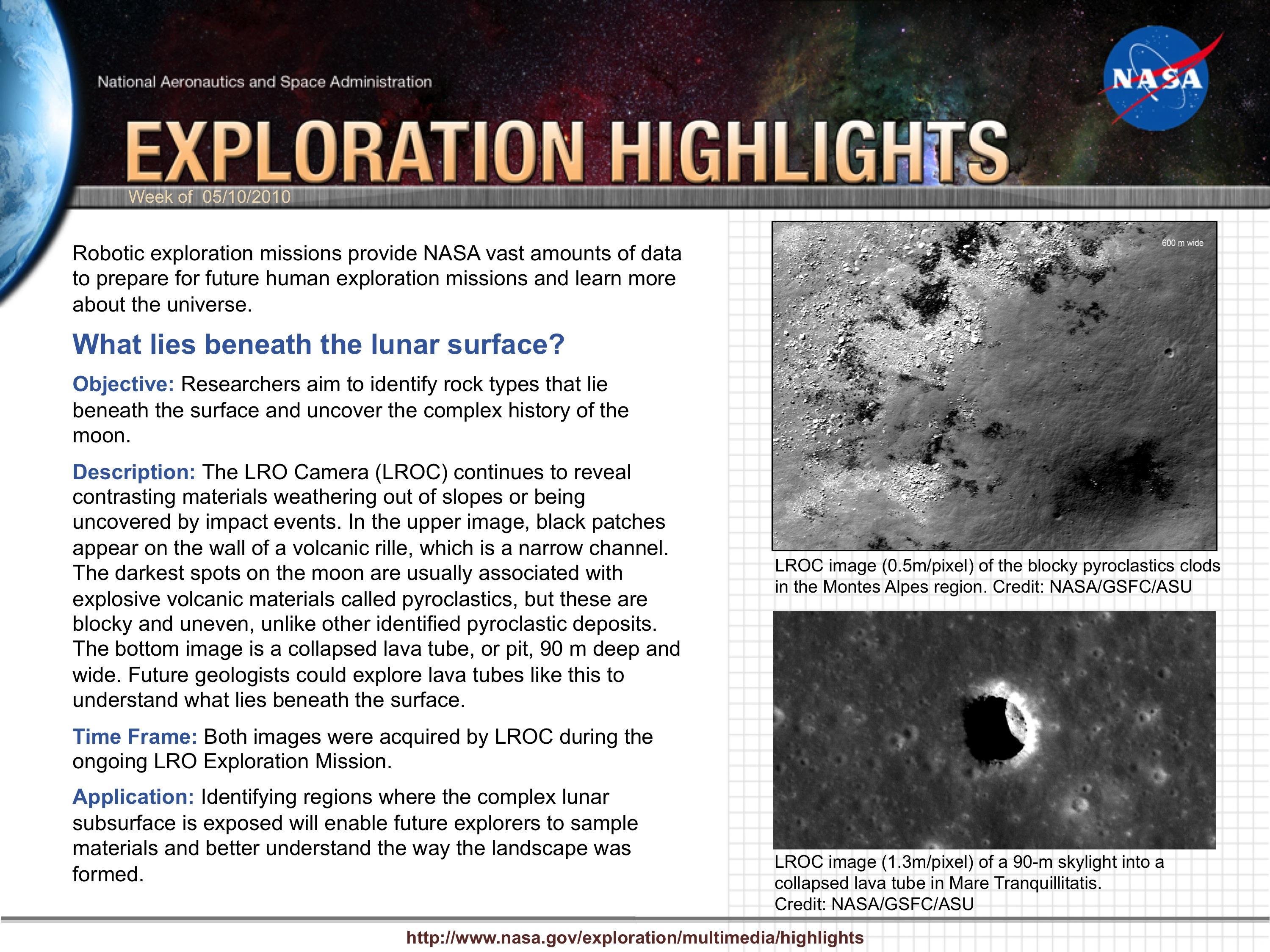 What lies beneath the lunar surface? DVIDS832714
 Mare Ingenii presumed lava tube skylight
 Lunar collapse pits
 Sinuous chain of collapse pits transitioning into a continuous uncollapsed segment of a lunar lava tube.
| Type | Subtype | Date | Description | Notes | Source |
|---|---|---|---|---|---|
| commons | image | What lies beneath the lunar surface? DVIDS832714 | Commons | ||
| commons | image | Mare Ingenii presumed lava tube skylight | Commons | ||
| commons | image | Lunar collapse pits | Commons | ||
| commons | image | Sinuous chain of collapse pits transitioning into a continuous uncollapsed segment of a lunar lava tube. | Commons | ||


